Binario 1
Advisory Scope
The main site is anchored to advisory work that can be discussed credibly today: diagnostic entry work, advisory projects, retained support and tailored enablement across customs, trade compliance, governance, indirect tax and cross-border operating models.
Core advisory pillars
Capability towers designed for predictable execution, defensible decisions and commercially readable mandate design.

Mandates usually start where corridor pressure meets weak control logic.
The services surface is designed to show where CSA Nexus leads, how work can be bought and where operating, digital or partnership layers become relevant without blurring the core offer.
Global Customs Compliance
- Classification, origin, valuation and broker-instruction governance.
- Customs file remediation across UK-EU and wider regulated trade flows.
- Audit-ready evidence packs and operating decision records.
Trade Compliance
- REACH, RoHS, CE/UKCA, CBAM, SPS and adjacent product-regulatory trade layers.
- Controls design, process ownership and escalation thresholds for border-facing product and route risk.
- Cross-functional alignment across compliance, operations, procurement, customs and finance.
Governance
- Operating-model design, evidence ownership, escalation routes and authority-ready decision memory.
- Cross-functional control frameworks joining customs, compliance, finance and operations.
- Senior-led mandate structure for buyers who need more than a topic memo or one-off filing answer.
Indirect Taxation
- Import VAT, PVA-style thinking and cross-border VAT governance.
- Customs valuation, TP alignment and finance-linked controls.
- Fixed-establishment and operating-model adjacency where relevant.
Export Controls & Sanctions
- EU and UK export controls with specialist US exposure analysis where relevant.
- Licensing workflow, ICP design and control governance.
- Sanctions, ownership review and response playbooks for sensitive flows.
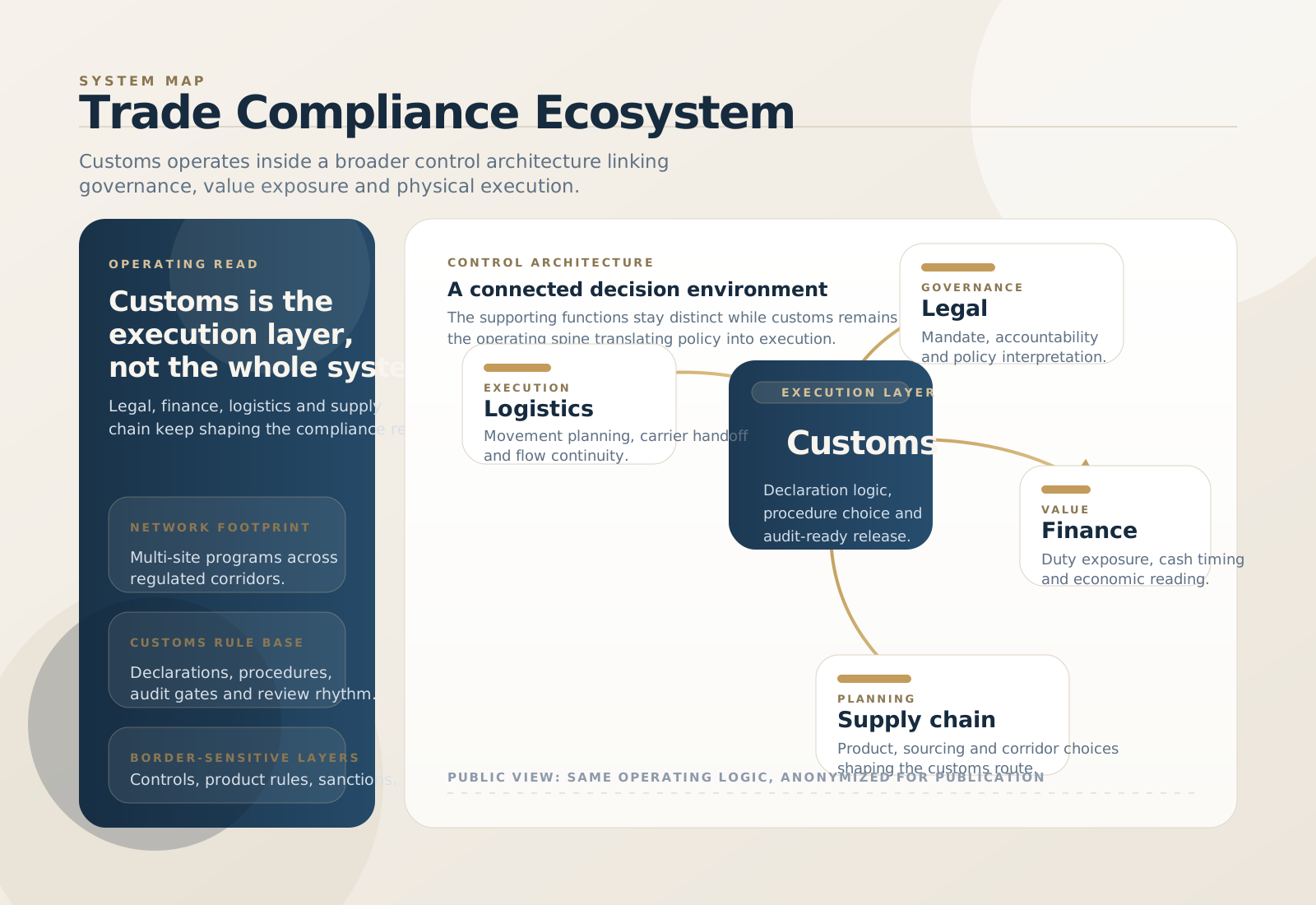
Customs is one decision layer inside a wider trade-compliance system.
The attached ecosystem slide worked because it showed customs in relation to legal, finance, logistics and supply-chain realities rather than as an isolated filing topic. The public version keeps that same logic, but with cleaner structure and non-identifying labels.
This matters commercially as well as technically: it helps a buyer understand why advisory work often starts at a customs pain point but quickly needs a broader control view if the mandate is meant to survive audit, corridor pressure and finance scrutiny.
Direct entry points into the advisory architecture
Macro-pillars remain important, but buyers often need a faster route into the specific topic already creating friction. The service architecture now makes those entry points more explicit.
Indirect Tax
Import VAT, postponed-accounting logic, fiscal representation, FE adjacency and customs-finance ownership design.
Open indirect tax scopeValuation & Transfer Pricing
Declared value, royalties, assists, intercompany pricing, year-end adjustments and customs-accounting evidence.
Open valuation and TP scopeProduct Conformity
GPSR, CE/UKCA, REACH, CLP, EPR, CBAM and product-governance logic that changes release and evidence requirements.
Open product conformity scopeOrigin & FTAs
Origin qualification, cumulation, LTSD discipline, supplier evidence packs and preference governance.
Open origin and FTA scopeSPS & Biosecurity
TRACES, IPAFFS, BCP readiness, controlled goods, documentary chains and route-sensitive release logic.
Open SPS and biosecurity scopeTrade Security
ENS, ICS2, pre-arrival controls, export controls, sanctions and security-facing documentary governance.
Open trade security scopeHow the offer is engaged
Mandates can start in different forms depending on urgency, scope and the maturity of the client operating model.
Diagnostic / Entry
Short scoping, pressure-point mapping and decision framing for clients that need to understand where the problem actually sits before launching a larger workstream.
Advisory Projects
Defined workstreams for remediation, operating-model redesign, control architecture, evidence rebuilding or cross-border policy implementation.
Retained / Fractional
Ongoing senior support where the client needs continuity, escalation judgement and cross-functional trade leadership without building a full internal team immediately.
Enablement Layer
Targeted templates, controlled tooling, decision frameworks and research assets that make the operating model easier to run and harder to dilute over time.
The main site is the advisory layer, not the sitemap for every connected surface.
Advisory pages stay here. International collaboration, governed digital infrastructure and operating partnership logic each have their own role and are linked contextually when they become relevant to the mandate.

One lead surface for advisory, with adjacent sites kept separate.
Capability overlap with CIESSE
The service perimeter is not split into two disconnected catalogues. CSA Nexus and CIESSE both sit across customs, trade compliance, governance, indirect-tax adjacency and export-controls-sensitive work. The distinct commercial plus of CIESSE is direct material execution of customs formalities and the surrounding documentary flow.
How buyers should read the difference
CSA Nexus remains the advisory and cross-border architecture lead. CIESSE remains a standalone operating company that can be bought directly or combined selectively when Italy/EU execution and documentary control materially strengthen the mandate.
Mandate formats and commercial logic
The service model should explain not only what CSA Nexus can discuss, but how the work is bought, what seniority sits where and why the client should expect economic value before any numerical pricing conversation starts.
| Mandate form | Typical trigger | What the client receives | Value logic |
|---|---|---|---|
| Diagnostic / Entry | Repeated corridor friction, unclear ownership, weak evidence or a board-level question that needs fast grounding. | Pressure-point map, initial technical framing, priority risks and a cleaner recommendation on what should happen next. | Reduces wasted escalation time and helps avoid launching the wrong project for the wrong root cause. |
| Advisory Project | A specific workstream on origin, valuation, controls, operating model, trust or corridor remediation. | Structured analysis, design choices, documented recommendations, frameworks and client-ready implementation guidance. | Improves repeatability, lowers rework and creates a stronger technical-commercial basis for decisions that will be reused. |
| Retained / Fractional | The business needs continuity of judgement without building a full internal team immediately. | Senior-led continuity, escalation support, ongoing cross-functional coordination and a more stable governance rhythm. | Gives access to experienced judgement with less fixed organisational weight and better continuity on recurring problems. |
| Enablement / Digital Support | The issue is no longer only technical; the client needs a more usable framework, evidence toolkit or controlled digital layer. | Templates, decision aids, supervised research packs and structured enablement connected to the mandate. | Makes the model easier to operate, less dependent on improvised judgement and more robust under staff change or growth. |
Defined-scope fee
Typical for diagnostics and tightly bounded advisory questions where the client needs a clear first answer and a fixed perimeter.
Project fee
Used for remediation, redesign and implementation workstreams with clearer outputs, decision owners and evidence expectations.
Retained support
Used where continuity of judgement, escalation coverage and management rhythm matter more than one-off analysis.
Hybrid / value-sensitive
Used selectively where project work, recurring support and economic upside interact closely enough to justify a more tailored commercial structure.
Sector and corridor focus
Focused playbooks for industry and corridor-specific risk, from SPS and logistics to aerospace and post-Brexit governance.
Logistics & Transport
Lane execution controls, exception handling and customs milestone governance.
ExploreAerospace & Defence
AOG resilience, release documentation and controlled movement playbooks.
ExploreCompliance Audit (231)
Assurance diagnostics, governance hardening and documented remediation programs.
ExploreWhere Italy-side operating execution matters, the partnership logic stays explicit.
CSA Nexus remains the advisory lead. CIESSE remains an autonomous operating company with materially overlapping technical capability and the additional strength of direct customs-formality execution. The relationship is used to strengthen delivery credibility on selected Italy-linked scopes, not to blur the two identities into a vague group narrative.
Not sure where to start?
Start from the advisory problem, not from an oversized menu. We will help identify the right entry point and whether retained support, partnership logic or enablement should be part of the discussion.
Request a scoping discussion